

Exhibition
- On view beginning Saturday, June 13, 2026
- Courtyard A
Opening Program: Pep Rally for the Trees, June 13, 2026 at 2pm
Artist and programmer Amanda Lovelee presents Homecoming at MASS MoCA, an immersive outdoor exhibition designed to remember a deeper connection between humans and nature, while playfully addressing the urgency of climate change that is causing plants to migrate. The project envisions MASS MoCA as a symbolic micro field station for two trees to participate in an assisted plant migration residency – a red oak from the southeastern US and a red oak from our local region (ancestral homelands of the Muhheaconneok, Mohican people or Munsee Lenape people). They are placed in proximity to each other, in city planters, to communicate and share VOCs.
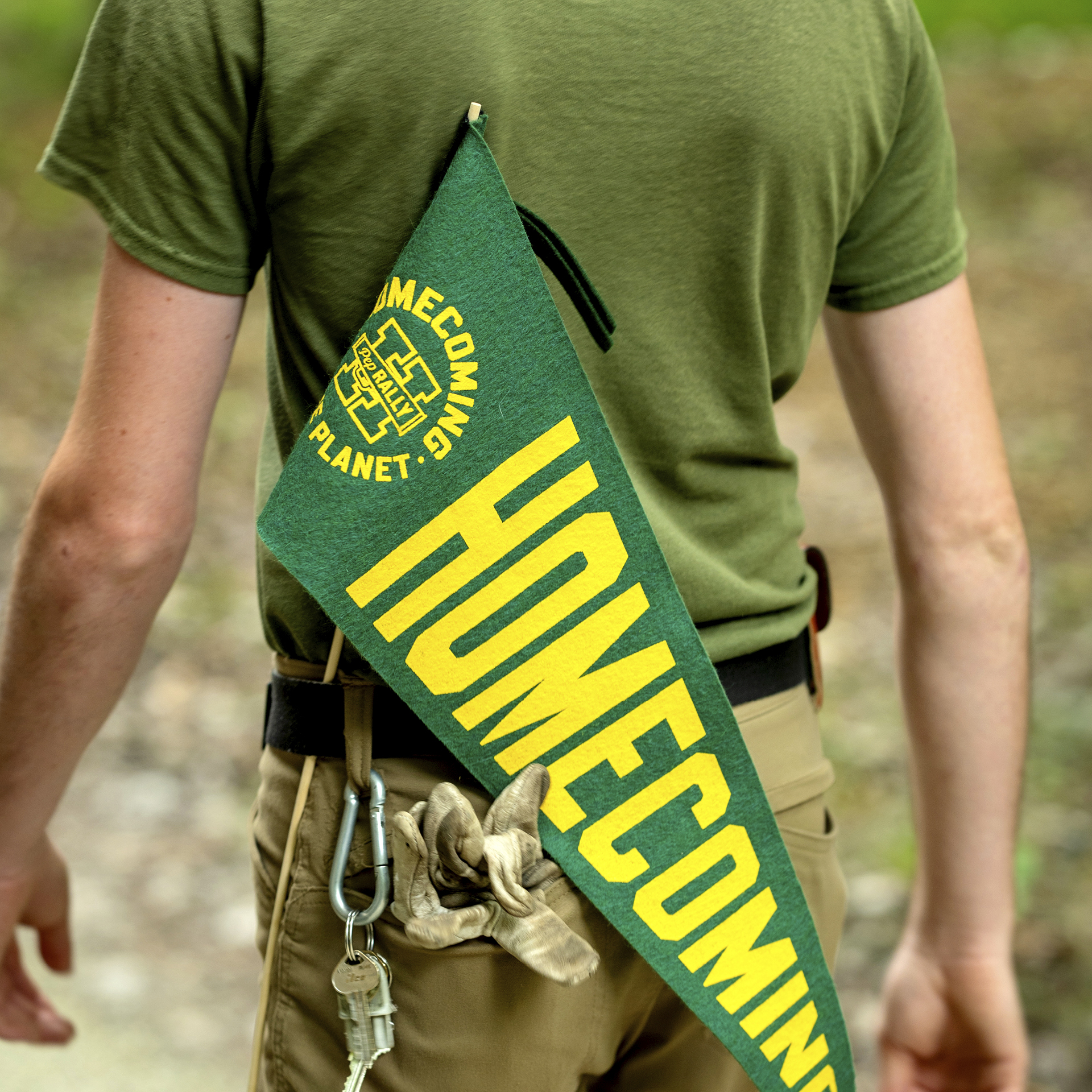
Central to this installation are custom-designed bleachers to watch two trees grow, and witness the time scale shifts of more-than-human beings. Joyful programming, pep rallies, and performances are planned to cheer on these trees while they participate in MASS MoCA’s assisted plant migration residency. This project is a symbol for plant resilience and an example of human intervention in, and care for, more than themselves.
Homecoming is in collaboration with plant scientist, artist, and educator Jessica Gersony and members of the PLACE (PLant physiology, Art and Community Engagement) Lab at Smith College.
About Assisted Plant Migration:
Assisted plant migration is the intentional movement of plants — typically native and long living plants, like trees — from a warmer climate to a cooler climate. As temperatures in the northeastern US feel more like those in the southern states over the coming years due to climate change, northeastern forests may benefit from having some trees that are more comfortable with, and adapted to, these hotter conditions. This practice is currently being researched and implemented across the country to support climate-smart forestry.
Trees don’t operate in isolation. Through many different means, southern-origin trees will be in a new community with northern-origin trees. For example, trees are able to communicate with each other by the exchange of volatile organic compounds (VOCs, tree hormones) through the air.
About the Artist:
Amanda Lovelee is a civic and environmentally focused artist working as Cultural Policy Fellow at Stanford University and founding member of CAIR Lab. Through the fellowship, she is focused on art and climate with residencies at CIRCLE, MN Pollution Control, NYC Parks Department of Natural Resources, and State of CA Office of Land Use and Innovation. Her public practice operates at the intersection of science, civic engagement, and systems change, using play and joy as methodological tools to invite broad public participation in climate-focused projects. Her work creates space for both grief and joy as necessary emotional conditions for collective reflection and movement toward action. She collaborates with governmental agencies and cross-sector partners, including scientists, planners, arborists, and water resource managers, on large-scale public art projects. She holds an MFA in Visual Studies from the Minneapolis College of Art and Design and a BFA in Photography from the University of Hartford, and her work has been supported by the National Endowment for the Arts, ArtPlace America, the Knight, Jerome, and McKnight Foundations, the Minnesota State Arts Board, and Salzburg Global Seminar.
Core support for the Department of Public Programs is provided by the WLS Spencer Foundation. Major support is generously provided by the national Leadership in Art Museums (LAM) initiative funded by the Alice L. Walton Foundation, Mellon Foundation, and Pilot House Philanthropy; the Feigenbaum Foundation; and the Ruth E. Proud Charitable Trust. Support is also provided by Anonymous (2); the Avangrid Foundation, in partnership with Berkshire Gas Company; the Robert Lehman Foundation; Berkshire Bank; Berkshire Taconic Community Foundation; and MountainOne.